TWO:The object of examining an accused man is the ascertainment of truth. But if this truth is difficult to discover from a man¡¯s air, demeanour, or countenance, even when he is quiet, much more difficult will it be to discover from a man upon whose face all the signs, whereby most men, sometimes in spite of themselves, express the truth, are distorted by pain. Every violent action confuses and causes to disappear those trifling differences between objects, by which one may sometimes distinguish the true from the false.
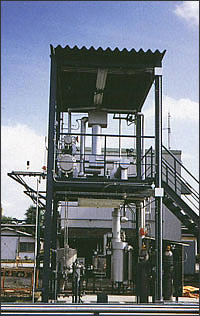
Great attention is recently being paid to global environmental issues, and it is now conceivable that companies will need to treat used solvents themselves. In consideration of this kind of social issue, we have developed a “membrane separation type solvent dehydration system,” which uses a polyimide membrane with superior dehydration properties developed by Ube Industries, Ltd. in combination with our own distillation and concentration technology that has resulted in solvents being more easily recovered.
THREE:But at least, it will be thought, we have by this time arrived at some principles about punishment which correspond with the eternal truths of equity. Is not Equality, for instance, one of the primary essentials of punishment? Does it not stand as a penal axiom with almost the sanction of a moral law that all men should suffer equally for equal crimes? Yet, if by equality be meant the same punishment, the same kind of labour, the same term of servitude, the same pecuniary fine¡ªand this is the only thing it can mean¡ªwhat more obvious than that the same punishment for rich and poor, for young and old, for strong and weak, for men and women, for educated and uneducated, will bring to the constitution of a penal code the utmost inequality the imagination can conceive? Beccaria insists that the law can do no more than assign the same extrinsic punishment to the same crime; that is, the same punishment, regardless of all other external considerations; and he calls for the infliction of the same punishment on the nobleman as on the commoner. Let it be so; but the same punishment is no longer an equal one; and hence from this very demand for equality springs the demand for its very opposite, for what Bentham calls the equability of punishment; that is, consideration[77] for the different circumstances of individual criminals. So that the same nominal punishment not being the same real one, equality of punishment appears to be a chimera, and the law, which punishes, say, a distinguished officer less severely than it punishes a costermonger for the same crime, errs perhaps really less from actual equality than if it condemned both to precisely the same punishment.
- 1Under the distillation system, even in case of azeotropic solvent compositions, this system which remove water vapor by the polyimide membrane will easily dehydrate.
- 2In comparison with the distillation system, it significantly saves on use of steam.
- 3Dehydration can be performed through merely supplying evaporated vapor to the membrane module and maintaining the differential pressure between the permeable side and the impermeable side.
- 4Solvent purity of 99.9% or more can be achieved by carrying out dehydration with a polyimide membrane only.
- 5The polyimide membrane has superior heat and solvent resistance. Therefore, the vapor permeation system reduces contamination of the membrane and thus extends its life.
THREE:
The aromatic polyimide membrane is highly permeable to water vapor but less permeable to vapors of organic compounds such as alcohol etc.
THREE:CHAPTER XXXVI. CRIMES OF DIFFICULT PROOF.CHAPTER IX. SECRET ACCUSATIONS.
- 1 Recovery of the detergent solvent Recovery of the cleaning solvent such as electronic parts industry, precision instrument industry.
- 2Solvent recovery and the refinement Solvent recovery and the refinement such as chemical industry, an industry of medical supplies, food industry, the fermentation industry.
THREE: Some remnants of the laws of an ancient conquering people, which a prince who reigned in Constantinople some 1,200 years ago caused to be compiled, mixed up afterwards with Lombard rites and packed in the miscellaneous volumes of private and obscure commentators¡ªthese are what form that set of traditional opinions which from a great part of Europe receive nevertheless the name of laws; and to this day it is a fact, as disastrous as it is common, that some opinion of Carpzovius, some old custom pointed out by Clarus, or some form of torture suggested in terms of complacent ferocity by Farinaccius, constitute the laws, so carelessly followed by those, who in all trembling ought to exercise their government over the lives and fortunes of men. These laws, the dregs of the most barbarous ages, are examined in this book in so far as regards criminal jurisprudence, and I have dared to expose their faults to the directors of the public happiness in a style which may keep at[112] a distance the unenlightened and intolerant multitude. The spirit of frank inquiry after truth, of freedom from commonplace opinions, in which this book is written, is a result of the mild and enlightened Government under which the Author lives. The great monarchs, the benefactors of humanity, who are now our rulers, love the truths expounded, with force but without fanaticism, by the obscure philosopher, who is only roused to indignation by the excesses of tyranny, but is restrained by reason; and existing abuses, for whosoever well studies all the circumstances, are the satire and reproach of past ages, and by no means of the present age or of its lawgivers.
Acetone, ethanol, methyl ethyl ketone, butanol, isopropyl alcohol, ethyl acetate, methyl isobutyl ketone, others (including hexane and toluene).
